Benefits of a Home Longevity Suite: 2026 Guide
Table of Contents
- Why a Home Longevity Suite Is More Than a Wellness Room
- Restorative Sleep and Circadian Rhythm Support
- Essential Longevity Technologies for Home Recovery
- Benefits of Red Light Therapy at Home
- Home Wellness Room Design: Layout, Air, and Light
- Retrofitting vs. New Build: What Homeowners Should Know
- ROI, Property Value, and Long-Term Maintenance
- Frequently Asked Questions
Last Updated: October 2, 2026
Why a Home Longevity Suite Is More Than a Wellness Room
A home longevity suite is a dedicated residential space where recovery technologies, air and water systems, lighting, and layout are planned together to support long-term health rather than occasional pampering.
Restorative Sleep and Circadian Rhythm Support
Sleep is the foundation everything else builds on. A longevity suite supports it by creating a wind-down environment and reinforcing the light cues that regulate your body clock.
Essential Longevity Technologies for Home Recovery
The core technologies in a longevity suite fall into a few categories: heat, cold, light, and oxygen.
Technology |
Primary Purpose |
Typical Session |
Space Needed |
|---|---|---|---|
Traditional sauna |
Thermal stress, relaxation |
15-30 minutes |
4x6 ft minimum |
Cold plunge |
Cold exposure, recovery |
2-5 minutes |
3x3 ft plus clearance |
Red light panel |
Light therapy, skin and recovery |
10-20 minutes |
Wall-mounted |
Hyperbaric chamber |
Pressurized oxygen therapy |
60-90 minutes |
Seated or reclined footprint |
Saunas and Cold Plunges for Thermal Stress
Contrast therapy, alternating heat and cold, is the most established recovery ritual in the suite. Heat drives circulation and relaxation; cold exposure follows with a sharp, invigorating reset.
Hyperbaric Oxygen Chambers for Cellular Health
Hyperbaric oxygen therapy delivers oxygen at elevated pressure, increasing how much oxygen your blood plasma can carry (pubmed.ncbi.nlm.nih.gov). Clinical chambers have long been used in medical settings, and interest in at-home use for recovery and general wellness has grown steadily.
Benefits of Red Light Therapy at Home
Red light therapy at home gives you consistent access to light-based treatment without appointments or per-session costs. Light therapy works through regular, repeated exposure, so a panel in your own suite removes the biggest barrier to results.
Home Wellness Room Design: Layout, Air, and Light
Design is where a collection of equipment becomes a suite. Three systems do the heavy lifting: layout, air, and light. Get these right and the room works even on the days you do not feel like using it.
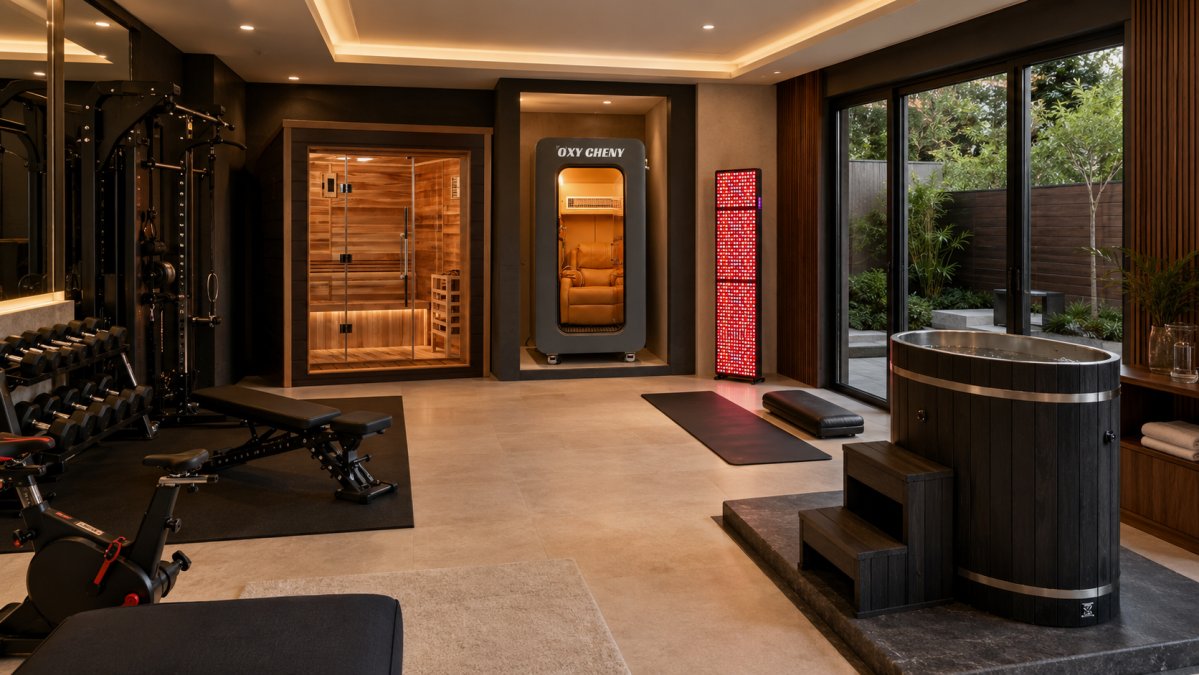
Person relaxing in a bright home wellness room featuring a cedar sauna, a cold plunge, and a red light panel.
Layout: Plan the Circulation Path First
Start with the path a person actually walks: enter, change, heat, cool, rest, exit. Keep the sauna and cold plunge within a few steps of each other so the contrast transition is not a hike across the house, and place a lounge or chair where you will genuinely cool down and recover.
Practical clearances most builders work from:
- Sauna: a 2-person traditional sauna typically needs a footprint around 4 x 6 ft, plus 30-36 in of clear floor in front of the door for safe egress.
- Cold plunge: a 3 x 3 ft tub needs roughly 24-30 in of clearance on the access side for entry, exit, and lid handling.
- Red light panel: mount so the panel face sits 6-18 in from your body at standing or seated height; a full-body panel covers more surface area per session than a handheld device and shortens the time commitment.
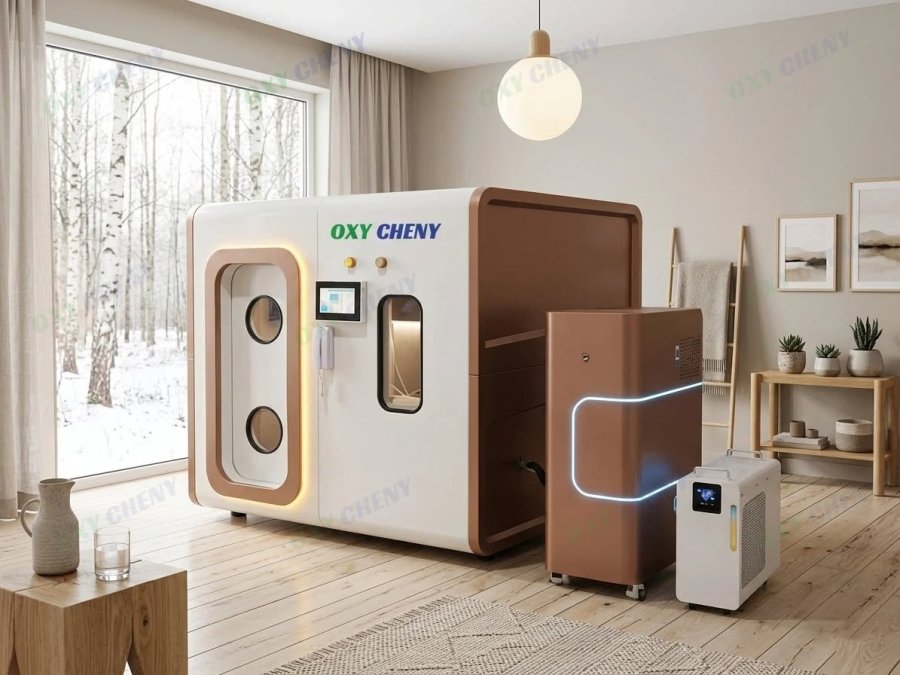
- Hyperbaric chamber: a seated hard-shell unit needs its own zone with room to open the hatch and to route the oxygen concentrator hose without a trip hazard.
Air: Ventilation, Filtration, and Moisture
Air quality deserves more attention than it usually gets. Saunas and chambers add heat and humidity, so ventilation and moisture management must be planned, not added later.
A few concrete levers:
- Dedicated exhaust for wet zones. A sauna and a plunge area should each have local exhaust rather than relying on the room's general HVAC return. A common pattern is a dedicated exhaust fan on a timer or humidity sensor so the room dries out after a session instead of staying damp.
- Makeup air. Exhaust only works if replacement air can get in. If the suite is a closed room, plan a transfer grille or a dedicated makeup-air path so the exhaust does not starve.
- Filtration. Many homeowners add filtration for particulates and VOCs, since indoor air quality is a direct lever on respiratory and cardiovascular health. Look for a MERV 13 or higher filter on the HVAC side, a standalone HEPA unit for the rest area, and a carbon stage for VOCs.
- Humidity control. A plunge and a steam sauna can push a small room toward condensation on cold surfaces. A dehumidifier sized to the room, plus moisture-tolerant finishes near the wet zone, prevents the mold-and-mildew problem that turns a wellness room into a maintenance headache.
If you only get one design decision right, make it airflow. Heat, humidity, and oxygen equipment all interact with your HVAC system, and retrofitting ventilation after the build is far more expensive than planning it upfront.
Light: Layer It to Your Circadian Rhythm
Light should be layered, not uniform: bright, cool light for morning and active use, warm, dimmable light for evening wind-down. This is the circadian principle applied to a whole room.
Golden Designs "Kuusamo" 6-Person →
A practical layering scheme:
- Morning / active: overhead or wall-wash lighting in the 4000-5000K range, bright enough to read by, on a switch you hit when you walk in.
- Evening / wind-down: warm sources in the 2200-2700K range, dimmable, positioned low (lamps, sconces, toe-kick lighting) so light is not hitting your eyes from above.
- Task lighting: a dedicated, bright source at the red light panel station so you can read or check your session without turning on the whole room.
- Daylight: if the suite has a window, keep it unobstructed in the morning. Ten to twenty minutes of bright light shortly after waking helps anchor the circadian rhythm, and a suite with good daylight exposure or a dedicated bright-light corner makes that habit easier to keep.
A Note on Acoustics
The most underrated design element in a longevity suite is sound. HVAC runs, plunge pumps, and concentrator compressors produce continuous noise, and sound transmission through shared walls disrupts sleep more than most people realize. Plan insulation and quiet equipment placement before aesthetics.
Retrofitting vs. New Build: What Homeowners Should Know
Retrofitting an existing room is realistic for most homeowners, but it carries constraints a new build does not: power, drainage, and structural capacity.
ROI, Property Value, and Long-Term Maintenance
Most guides stop at the health benefits and never cover what a longevity suite costs to own or what it does to your home's value. That is the gap this section fills.
Resale Value: What Actually Appears in an Appraisal
Resale value from a longevity suite is real but uneven: permanent, built-in infrastructure holds value better than plug-in equipment.
- Built-in and hardwired: a framed sauna, a plumbed cold plunge with proper drainage, dedicated circuits, and designed ventilation read as part of the home, similar to a finished basement or a home gym. These are the features an appraiser or buyer can see and verify.
- Plug-in and portable: a freestanding red light panel, a countertop concentrator, or a fill-and-drain plunge tub are treated more like appliances. They can be sold with the home or removed, and they add less to a valuation.
A Realistic Maintenance Calendar
Maintenance is the difference between a suite that holds its value and one that frustrates you within a year. Budget for it as an ongoing cost, not a one-time purchase.
System |
Routine Task |
Typical Frequency |
|---|---|---|
Traditional sauna |
Wipe benches, ventilate, inspect heater and stones |
After each session / monthly |
Traditional sauna |
Deep clean wood, reseal or re-oil as needed |
Every 6-12 months |
Cold plunge |
Test and balance water, clean filter |
Weekly |
Cold plunge |
Drain, sanitize, and refill |
Every 1-3 months |
Hyperbaric chamber |
Inspect seals and hoses, service concentrator |
Per manufacturer schedule |
Red light panel |
Dust the panel face, check cords and mounting |
Monthly |
Whole suite |
Replace HVAC filter, check exhaust and dehumidifier |
Every 1-3 months |
The Hidden Costs Most Buyers Miss
Three costs catch homeowners off guard:
- Electricity. A traditional sauna and a hyperbaric chamber are the two biggest draws. A 20-30 minute sauna session at typical residential rates adds a measurable amount to a monthly bill, and a 60-90 minute chamber session adds more.
- Water and consumables. A plunge tub that is drained and refilled every few weeks uses real water, and sanitizing chemicals, filters, and replacement parts are recurring line items.
- Service calls. Concentrator servicing and any HVAC or plumbing repair in a wet zone cost more than the same work in a dry room because of the moisture and equipment density.
Before you buy, ask each manufacturer for the recommended service interval and the cost of the consumables (filters, seals, chemicals). A suite that is cheap to buy and expensive to own is a worse deal than one with a higher upfront price and a light maintenance load.
The Bottom Line on ROI
Treat the suite as a lifestyle asset first and a resale play second. The homeowners who get the most value build a routine around the space and keep up with maintenance: a well-maintained suite stays pleasant to use and holds its value, while a neglected one frustrates you within a year.
Frequently Asked Questions
What is a home longevity suite?
A home longevity suite is a dedicated residential space that combines premium wellness equipment such as saunas, cold plunges, red light therapy panels, and hyperbaric oxygen chambers. Unlike a home gym, it focuses on recovery, relaxation, and long-term healthspan rather than just exercise. Heaven Life Wellness offers curated products like the Golden Designs "Kuusamo" sauna and OxyCheny hard-shell chambers to help homeowners build these spaces.
What technologies are essential for a home longevity suite?
The core technologies include a sauna for thermal stress, a cold plunge for contrast therapy, red light therapy for skin and cellular health, and a hyperbaric oxygen chamber for pressure-based recovery. Air filtration, circadian lighting, and acoustic insulation support the environment. Heaven Life Wellness carries the Golden Designs "Toledo" hybrid sauna and OxyCheny CY5 chamber, which are designed for residential integration.
What are the benefits of red light therapy at home?
At-home red light therapy offers convenience and consistency, which are key for results. It supports skin health, muscle recovery, and cellular energy production. The SL5000 Full Body Red Light Wellness Panel (rated 4.8 stars) gives a standalone option. Using it daily for 10-20 minutes is typical.
Is a home longevity suite a good investment for property value?
A well-designed suite can increase property value by adding a unique, high-demand feature. It also supports preventive care and may reduce the need for external spa visits. However, ROI depends on installation quality and local market demand. Retrofitting an existing room is often more cost-effective than a new build. Heaven Life Wellness provides integration guidance to help homeowners plan for long-term value.