Article: Best Infrared Sauna for Home Use: 2026 Buyer's Guide
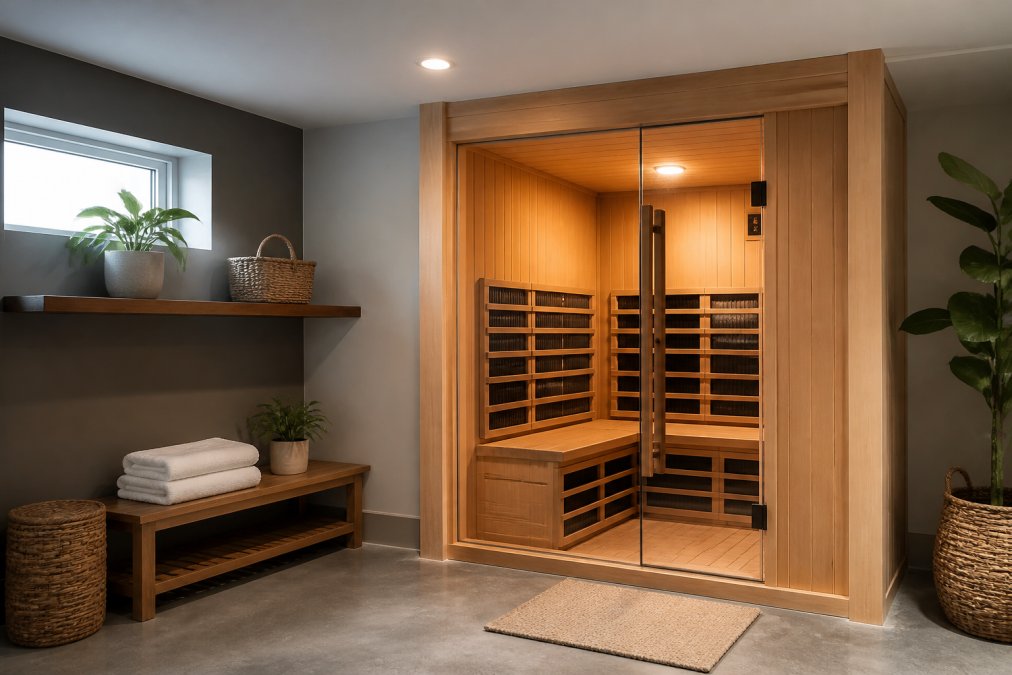
Best Infrared Sauna for Home Use: 2026 Buyer's Guide
Table of Contents
- What Separates a Good Home Infrared Sauna From a Great One
- How Long to Stay in an Infrared Sauna for Real Results
- Low EMF Infrared Sauna Brands: What the Ratings Actually Mean
- Home Sauna Installation Requirements: Space, Power, and Ventilation
- Full Spectrum vs. Near-Infrared vs. Far-Infrared: Which Do You Need?
- Long-Term Maintenance Costs Most Buyers Overlook
- Conclusion
- Frequently Asked Questions
Last Updated: September 23, 2026
What Separates a Good Home Infrared Sauna From a Great One
Shopping for the best infrared sauna for home use comes down to two things most buyers underestimate: how the heater distributes heat and what the cabin is made of. At Heaven Life Wellness, we guide homeowners to consider the specs that determine whether they'll actually use the sauna five years from now.
Heater Type and Heat Distribution
Carbon heaters spread heat evenly across a wide panel and run cooler to the touch. Ceramic heaters heat up faster and push more intense heat from a smaller surface. Full-spectrum cabins mix carbon, ceramic, and near-infrared emitters to cover more of the light spectrum.
Cabin Materials and Off-Gassing
Cedar and hemlock are the two woods you'll see most. Cedar resists moisture and smells distinctive; hemlock is lighter and costs less. The bigger issue is off-gassing, the release of volatile compounds from adhesives, stains, and lower-grade lumber.
How Long to Stay in an Infrared Sauna for Real Results
Most people get the best results from 20 to 40 minutes per session, three to four times a week. Beginners should start at 15 minutes and build up.
- Relaxation and stress reduction: 20-30 minutes at a comfortable setting
- Muscle recovery after training: 30-40 minutes, ideally within a few hours of activity
- General wellness routine: 20-30 minutes, most days
Low EMF Infrared Sauna Brands: What the Ratings Actually Mean
Electromagnetic fields (EMF) and extremely low frequency (ELF) readings are the numbers behind the "low-EMF" label. Every electrical device produces some EMF, so the question is how much and where it's measured. But "low EMF" is not a regulated term in the United States, no federal standard defines a maximum allowable EMF level for a residential infrared sauna, so a brand can print "low EMF" on a box without third-party verification.
The Units You'll See on a Spec Sheet
Two measurements show up in sauna marketing, and they are not interchangeable:
- Milligauss (mG) measures magnetic field strength. This is the number most sauna brands quote, usually taken near the heater panel.
- Volts per meter (V/m) measures electric field strength. Fewer brands publish this, but it matters because electric fields are the component most often associated with the wiring and control panel rather than the heater itself.
Why a Single Number Is Almost Meaningless
EMF strength drops sharply with distance. A reading 2 inches from a heater panel can be many times higher than one at seated head height in the middle of the cabin, so the same cabin can be called "low EMF" or "high EMF" depending entirely on where the meter was held.
- The meter make and model used for testing
- The exact measurement points inside the cabin (for example: seated head height, seated torso height, foot level, and directly against each heater)
- Which heaters were powered on during the test, carbon, ceramic, or near-infrared emitters
- Whether the reading is in milligauss or volts per meter, and whether both were recorded
- Whether the test was performed by the manufacturer or an independent lab
A Practical Way to Compare Without a Lab
You don't need to be an engineer to sanity-check a claim. A handheld EMF meter that reads in milligauss is widely available, and the same model used consistently across two cabins gives a fair relative comparison even if the absolute numbers aren't lab-grade.
ELF, Wiring, and the Parts Buyers Forget
ELF refers to the very low end of the electromagnetic spectrum, generally the frequencies associated with household power. In a sauna, the ELF sources are the power supply, the control board, and the wiring runs, not the infrared light itself. Infrared is a different part of the spectrum entirely.
What to Do With All This
Treat EMF claims like any other unregulated marketing term: a starting point, not a conclusion. A brand that publishes its test methodology, names its meter, and shows readings at multiple points gives you something to evaluate; a brand that publishes a single number with no context is asking you to take its word for it.
Home Sauna Installation Requirements: Space, Power, and Ventilation
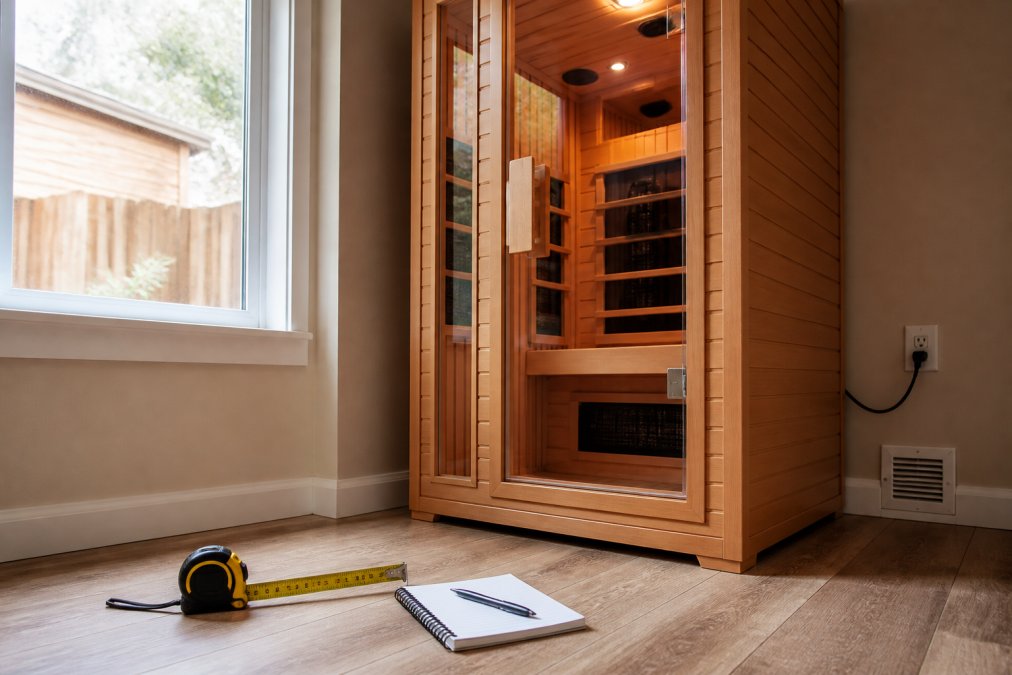
Home sauna installation requirements come down to three things: floor space, electrical capacity, and airflow. Get these wrong and you'll be renovating instead of relaxing.
Pre-Purchase Site Preparation Checklist
Before you order anything, work through this list:
- Measure the room and confirm door widths and hallway turns for delivery
- Check your electrical panel for open breaker capacity
- Decide whether you need a 120V or 240V unit
- Confirm the floor can handle the loaded weight
- Plan ventilation paths for moisture
- Verify the delivery route can accommodate the crate size
Full Spectrum vs. Near-Infrared vs. Far-Infrared: Which Do You Need?
Full spectrum cabins emit across near, mid, and far-infrared wavelengths. Near-infrared penetrates shallowly and is marketed for skin and surface tissue. Far-infrared penetrates deeper and is what most people associate with the classic sauna sweat.
Long-Term Maintenance Costs Most Buyers Overlook
The purchase price is the easy part. What catches owners off guard is what comes after, the part most buying guides skip.
Electricity Is the Largest Recurring Cost
An infrared sauna's electricity use is driven by three variables: the wattage of the heater array, how long the cabin takes to reach your target temperature, and how long you actually sit in it. A typical two-person full-spectrum cabin draws roughly what a residential space heater does when all heaters run; a smaller one-person far-infrared unit draws less.
You can estimate your own cost with three numbers:
- The cabin's rated wattage (listed on the spec sheet)
- Your electricity rate, which appears on your utility bill in cents per kilowatt-hour
- Your total session time, including pre-heat
The Wear-and-Tear List
Item |
Typical Interval |
Why It Matters |
|---|---|---|
Heater panel replacement |
5-10 years |
Panels lose output gradually; you notice it as longer pre-heat times |
Wood re-sealing |
2-3 years |
Protects against moisture damage and keeps the interior from drying and cracking |
Control panel repair |
As needed |
Digital boards fail with heat cycling; this is the most common electronic failure |
Door seal and hinges |
3-5 years |
Loose seals waste heat and power, which shows up on your electric bill before you notice the draft |
Ventilation grille cleaning |
Quarterly |
Blocked vents trap moisture and can lead to mold in the wall cavity |
Floor and bench hardware |
As needed |
Screws and brackets loosen with repeated heat expansion and contraction |
The Cost Drivers Nobody Lists
Three factors change the math more than any single part:
- Part availability. A cabin from a brand that stocks replacement heaters and control boards for a decade costs less to own than one from a brand that discontinues a model after two years. Ask how long parts will be available and what a heater panel costs today.
- Heater type. Carbon panels tend to outlast ceramic elements because they run cooler, but they take longer to reach temperature. That trade-off shows up in both the parts and electricity columns.
- Wood species and finish. Cedar resists moisture better than hemlock and needs less frequent re-sealing. The upfront price difference can be partly recovered over the cabin's life.
A Simple Way to Sanity-Check Total Cost
Add up three numbers before you buy: estimated annual electricity cost, the current price of one replacement heater panel, and the current price of a control board. If a brand can't give you the last two, that's useful information. A low sticker price with no parts pipeline isn't actually cheaper over ten years.
Conclusion
Choosing the best infrared sauna for home use isn't about the cheapest cabin or the longest feature list. It's about matching heater type, materials, electrical capacity, and maintenance expectations to how you'll actually use it. Heaven Life Wellness helps homeowners work through exactly that: our clinician-led team, founded by Andrea Bouchard, CRNA, guides you through product selection, site planning, and integration so your sauna fits your space and routine from day one.
Frequently Asked Questions
What is the downside to an infrared sauna?
Infrared saunas take longer to pre-heat than traditional steam units, often 10-20 minutes, and they do not produce the same humid heat some users prefer. Budget models may emit higher electromagnetic fields (EMF) and use lower-grade wood that off-gasses. They also require a dedicated circuit in many homes, and long-term maintenance costs for heater replacement and cabin care add up over time.
What should I look for regarding EMF levels in home saunas?
Ask the manufacturer for specific EMF and ELF readings at typical seating positions, not just 'low EMF' marketing language. Look for third-party test results or published milligauss (mG) numbers. Carbon and ceramic heaters vary widely in emissions, and cord routing affects readings too. A sauna that tests below a certain milligauss level at the bench is generally considered low EMF for home use.
Is a home infrared sauna worth the investment for recovery?
For people who use it consistently, yes. Infrared heat supports muscle recovery, cardiovascular health, and stress reduction as part of a regular wellness routine. The key is frequency: consistent sessions of appropriate duration. If you can commit to that schedule and have the space and electrical capacity, a home unit can be a valuable investment.
What are the electrical and space requirements for installing a home sauna?
Electrical and space requirements vary by model. Many two-person infrared saunas may require a dedicated 120V/20-amp circuit, while larger units often require 240V. It's important to check your electrical panel for available capacity before buying. For space, allow adequate clearance around the cabin for ventilation and access. A typical two-person unit can fit in a footprint suitable for many master bathrooms or spare rooms, but specific dimensions should always be verified.